Nokia is on a path of reinvention. The company is making bold moves under chief executive, Justin Hotard, to extend its reach across mobile network operator and enterprise markets. The acquisition of Infinera last year strengthened its already well-established optical networking portfolio that is optimized to facilitate AI data center clustering. The recent sale of Nokia’s fixed wireless access business to Inseego also signals an intention to redirect its engineering efforts to provide AI connectivity infrastructure at a massive scale. By all measures, the company is doubling down on AI.
This week, Nokia continued its ambitious AI journey by staking a claim to becoming the first infrastructure provider to commercialize AI-RAN. Let’s unpack the announcement and highlight what is significant about its latest move.
The Value Of AI-RAN
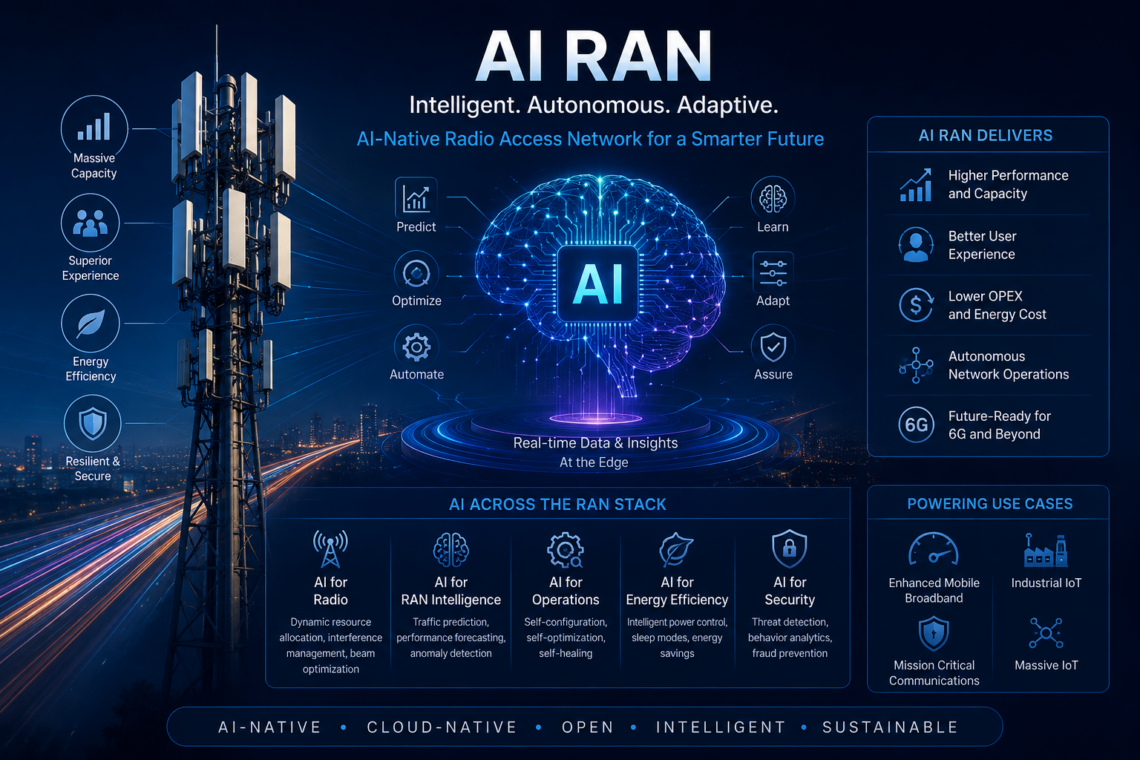
The value of AI-RAN is immense. Its capability to dramatically improve spectral efficiency is compelling given the costly operator investments made in spectrum licensing. Furthermore, AI-RAN’s software-designed nature, which easily integrates with existing hardware infrastructure, makes it attractive from both an operational management and economic standpoint.
Distributed AI inference is expected to explode, and mobile networks will play a vital role in moving data and unlocking new edge AI applications and use cases. AI-RAN has the potential to dramatically improve both uplink and downlink capacity to keep pace with these demanding AI workloads, and its open and programmable nature is poised to foster developer innovation.
Nokia’s AI-Native Network Architectural Approach
Nokia has been keenly focused on refining its autonomous networks platform powered by AI. Last June, the company launched its Autonomous Network Fabric, giving service providers access to robust observability, analytics, security, and automation capabilities to unlock deeper levels of assurance, AI runtime protection, self-healing, and intent-based service delivery. As the fabric has matured through a collaboration with Google Cloud to build telco-trained AI models, it establishes a solid foundation for Nokia to innovate with a single fabric that supports any workload within the radio access network infrastructure layer.
Nokia’s AI-RAN platform combines the strengths of its AI-native network architectural approach with NVIDIA’s Aerial AI-RAN stack to create a force multiplier for efficiency, performance, and future operator monetization. Nokia claims that today, it is unlocking more than a 20% gain in spectral efficiency, intending to increase it by more than 100% over the next two years. Those are huge improvements that are necessary to keep pace with the explosion of network traffic expected to result from persistent agentic operations. Nokia’s customers, including BT, NTT Docomo, T-Mobile, Vodafone, and others, should all be eager to reap the benefits.
Nokia is offering multiple paths to AI-RAN adoption, including a new GPU-powered AirScale RAN plug-in that is designed to easily integrate the power of NVIDIA’s accelerated computing capacity into existing mobile network infrastructure through an all-in-one baseband node. As a result, operators can process more data within the same spectrum footprint and leverage the flexibility to run on Nokia’s purpose-built hardware or common off-the-shelf servers.
Diving Deeper Into Nokia anyRAN
Underpinning Nokia’s AI-native network architecture is its anyRAN software and framework. It is designed to support 4G LTE, 5G New Radio, and anticipate future 6G 3GPP standards and requirements. Nokia anyRAN’s strength lies in its open, flexible, and measured approach to RAN evolution, meeting operators where they are from an infrastructure deployment standpoint.
These efforts build upon a well-established Nokia anyRAN partner ecosystem, providing a common software stack that is designed to deliver feature and performance consistency across a diversity of deployment scenarios. It also facilitates cloud RAN implementations and is fully Open RAN compliant, leveraging open standards to mitigate vendor lock-in and reduce costly capital expenditures.
Final Thoughts
Nokia is making big bets with AI, and its latest AI-RAN announcement punctuates its efforts. The opportunity to dramatically improve mobile network capacity through newfound spectral efficiency to keep pace with demanding AI workloads is significant. Most importantly, the ability to do so through a software-defined subscription-based model represents a needed departure from traditional and more costly hardware-centric upgrade cycles in the past.
Nokia’s commercialized AI-RAN offering has the potential to translate to faster time to operator innovation and monetization beyond access with emerging use cases, including integrated sensing and communication and physical AI. Success for Nokia will lie in the consistent execution of its engineering efforts, but its prospects are bright.