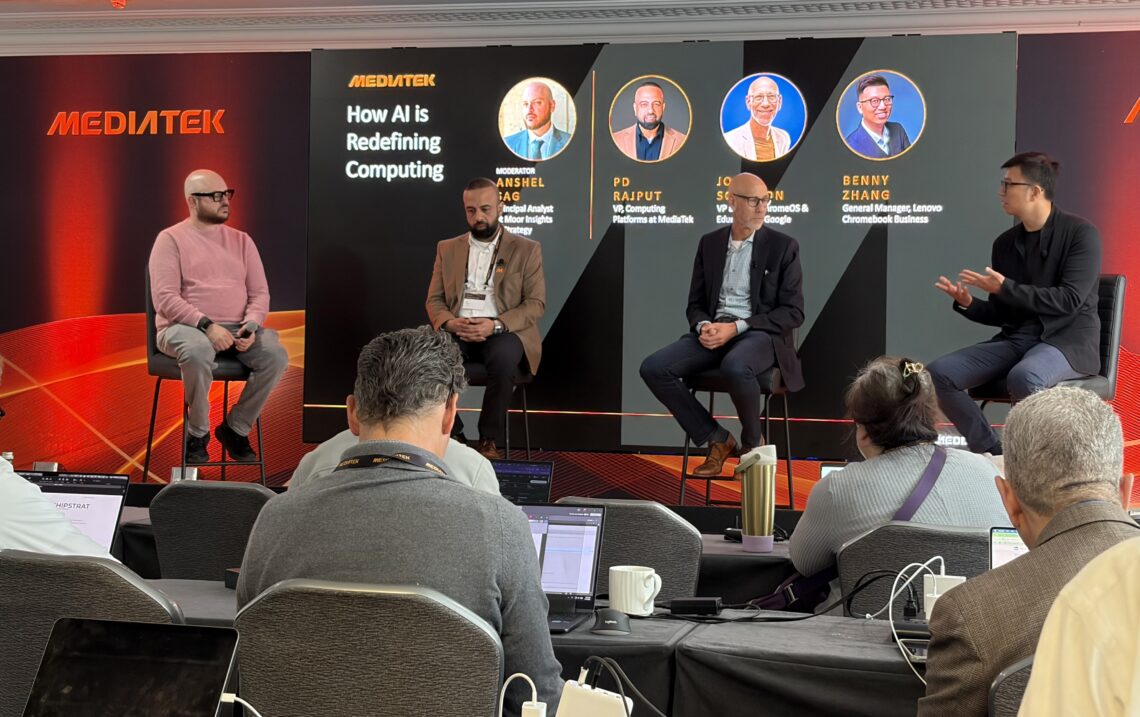
MediaTek welcomed a group of industry analysts to its annual event at the beautiful Ritz-Carlton in San Francisco’s Nob Hill district this week. I have always loved the hotel’s early 1900s Neoclassical architecture, and in many ways, its symmetry and simplicity echo MediaTek’s corporate DNA and humble yet confident culture.
With a continued theme of summarizing my event attendance with three big takeaways – let’s dive in!
No Longer The Value Play
Historically, MediaTek has competed with Qualcomm in mobility SoCs as a value play. The strategy served the company well, allowing it to establish a leading position in the category. However, through a relentless pursuit of silicon development, solutions, including its Dimensity family, have enabled it to move upmarket into premium categories.
Consequently, the company’s focus on sophisticated computing architectures is unlocking new design win opportunities with OEMs. I learned this week that MediaTek collaborated with NVIDIA to design the DGX Spark, an AI mini desktop marketed as a supercomputer. The heart of the Spark is the GB10 Grace Blackwell Superchip, which leverages MediaTek’s deep capabilities in power efficiency, memory subsystems, and high-speed interfaces. It clearly demonstrates that MediaTek has the chops to move beyond low-cost silicon and participate meaningfully in the modern AI gold rush. As OpenClaw continues to gain momentum, it also provides MediaTek with an opportunity to capitalize on the ability to create task agents on endpoint devices.
Doubling Down On Market Reach
MediaTek’s executive team shared its broad plans for North America expansion this year. Five key areas include compute, IoT and wearables, automotive, mobile, and data center, with data center being its top priority. These are all logical targets and align with its biggest competitor, Qualcomm. That mission presents a challenge given Qualcomm’s much broader recognition and market reach. To overcome it, MediaTek is embarking on a broad awareness campaign this year under its chief marketer, Rahul Sandil, who joined the company a little over one year ago from Micron.
I had an opportunity to spend time with Sandil, and he recognizes the need to clean up the branding that spiraled out of control and created market confusion. Earlier this month, MediaTek announced its plans to better unify product families, including nesting its computing and automotive products under the Dimensity sub-brand. The company is also embarking on joint marketing with its OEM and channel partners to broaden awareness, accelerate design win opportunities, and sell more of its solutions. As a former channel seller and marketer, I find it to be a masterful plan with enormous potential to move the sales needle.
Edge AI For The Win
Infrastructure providers are intensively focusing on enterprise AI applications and workloads. MediaTek recognizes the opportunity, and it is quickly pivoting its broad and deep silicon development capabilities to take full advantage. Inference at network edges represents a significant sales opportunity, as edge AI is poised to deliver the efficiency, sustainability, and performance advantages needed for AI use cases.
MediaTek’s NeuroPilot platform aims to capitalize on edge AI, integrating AI across its entire portfolio, including mobile, IoT, and automotive. It includes a set of tools, APIs, hardware support, and AI-assisted coding to accelerate time-to-market solutions. Building an ecosystem approach to scale design adoption is a proven winning strategy. There is every indication that MediaTek can succeed with NeuroPilot and a focus on enabling rack-scale infrastructure to compete with Qualcomm.
Final Thoughts
MediaTek’s recent record 2025 earnings clearly reflect that its investment in the enterprise market is paying off. Moving beyond its leadership in consumer smartphone SoCs into data center, edge, and cloud AI is driving significant top-line revenue growth and profitability. This is fueling its research and development efforts and unlocking innovation, and design wins with NVIDIA and others, including a recent one with Dell Technologies for AI consumer PCs.
Having a stronger competitor to Qualcomm is good for the tech industry. It will raise market innovation and provide more choice. It will be fun to watch what unfolds.