
Cisco recently held its signature Live event in the United States, returning to Las Vegas and featuring over 1,200 sessions, including keynotes, technical demos, and breakouts. Themes related to scaling networking for AI, securing the agentic workforce, and reimagining operations dominated agendas, and I had the opportunity to spend time with company executives, customers, and partners to dive deeper into deployments and business outcomes.
The launch payload was massive again this year as Cisco continues to move its solution development at the speed of modern AI. With a continued practice of summarizing my event attendance with three big takeaways – let’s dive in!
Maintaining Control Through Chaos
This year marks a decided shift within the enterprise as agentic AI moves from experimentation to deployment. To help its customers keep pace and navigate a chaotic environment filled with geopolitical pressures and an evolving AI threat landscape, Cisco launched its Cloud Control platform at Cisco Live. Broadly speaking, Cloud Control provides a single pane of glass to facilitate network assurance and security posture, the ability to easily manage fabrics, agentic workflows, and operations, and build apps and agents with natural language.
Cisco positions Cloud Control as delivering simplicity without losing sophistication. On the surface, it is a solid claim that further reinforces the company’s move towards becoming an AI infrastructure platform. However, I find fault with its name. There is a gravity towards private AI with sovereign infrastructure deployed on premises and air gapped within enterprises. As a former product marketer and given the hybrid nature of AI, I would have chosen a less limiting name, such as Agentic Control.
Chief product officer Jeetu Patel shared a mind-blowing statistic during one of his keynote presentations that is also worthy of mention. On average, a non-human agent generates 450% more network traffic than a human. This points to the need for both deep agentic observability and a consolidated management plane to simplify and optimize operations. Cisco Cloud Control has great promise to accomplish these objectives as it launches with controlled availability in the U.S. at launch today, with global availability to follow.
A Smarter Customer Experience
I have had the opportunity to spend time with the Cisco customer experience team at analyst summits in New York City last year and Paris this year, diving deeply into the company’s development of Cisco IQ. Initially launched last November, Cisco IQ is designed to deliver real-time insights, on-demand assessments, troubleshooting, and personalized learning. I have been impressed with the speed of its development and what the platform will potentially unlock to help enterprises manage infrastructure through the power of agentic AI. It is also a game changer for Cisco partners, enabling them to support customers more strategically while also providing meaningful service revenue upside.
At Cisco Live, the company’s chief customer experience officer, Liz Centoni, spoke about meeting the Mythos moment and how Cisco IQ has the potential to enable defenders to fight the weaponization of AI with AI. I call it the impending patch tsunami, and with Project Glasswing and the concerns of bad actors replicating the same ability to scan code bases at machine speed and identify critical vulnerabilities for exploitation, Cisco IQ is powerful. It offers resiliency with recent Resilient Infrastructure Services, new assessments, including quantum readiness, integration within Cloud Control, and future peer benchmarking capabilities.
Since its general availability, over 2,000 customers have signed up to leverage Cisco IQ to inventory infrastructure estates, employ proactive resiliency, and resolve critical vulnerabilities. That is a powerful testament to its current capabilities, and I expect new features and functionality to be added as the AI threat landscape evolves over time.
Shields Up!
Cisco Live Protect is an AI runtime vulnerability shielding system that acts as a compensating control that does not require taking infrastructure out of production. It functions as a bridge, allowing administrators the time needed to prepare and deploy permanent patches.
At Cisco Live, the company announced an expansion of Live Protect to shield additional Cisco solutions from vulnerabilities at runtime. Today, Nexus switches are enabled, and it is expected that campus and branch smart switches will follow in August, with routers, additional campus wireless controllers, and SD-WAN integrations planned soon.
Live Protect is a compelling feature, something that I expect will be replicated by other AI infrastructure providers as enterprises brace for widespread patching. I also anticipate that with the recent expansion of Project Glasswing to an additional 150 infrastructure providers, it could dramatically scale the availability of both new compensating controls and runtime security provisions. However, it also increases the likelihood of releasing the genie from the bottle in the wild with broader access to the Claude Mythos Preview model.
Final Thoughts
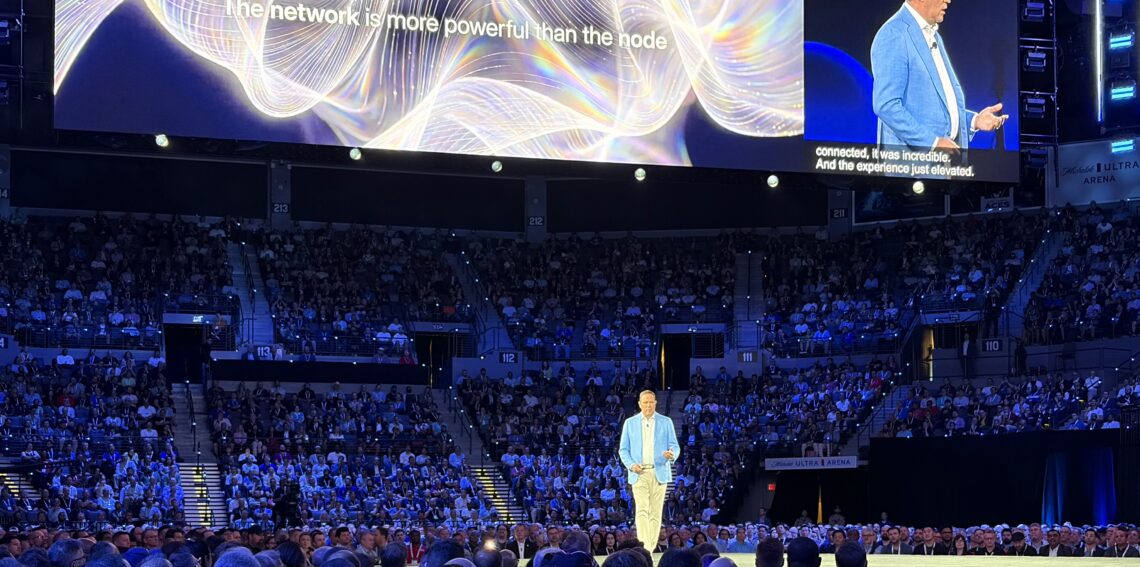
Chief executive Chuck Robbins shared during his opening keynote that “the network is more powerful than the node” as he spoke to the company’s innovation with routing four decades ago. The same can be said today of the importance of networking in scaling the transformative power of AI, and networking continues to be one of Cisco’s superpowers.
However, Cisco has also painstakingly reinvented itself over the past few years. Once a networking powerhouse that dabbled in cybersecurity, it is now a legitimate provider of critical infrastructure for the AI era. Cisco Cloud Control, Cisco IQ, and Live Protect all serve as proof points of the company’s investments in a complete tech stack that includes custom silicon and optics, a reinvigorated compute platform with a little help from NVIDIA, tightly integrated networking and runtime security, and a bevy of applications and agentic operational enablement.
I also believe that an emerging AI threat landscape and closer enterprise scrutiny of aging infrastructure will trigger a refresh cycle on the scale of what was seen with Y2K client refreshes. Cisco is in a fantastic position to reap the rewards and materially help its customers navigate a complicated IT landscape, given its continued roadmap innovation and AI platformization.