I recently attended Hewlett-Packard Enterprise Discover in the United States, meeting with the company’s executive leadership and product teams. This year’s event was especially significant, highlighting HPE’s progress with integrating its hotly contested acquisition of Juniper Networks, which was finally approved by regulators last July.
I was bullish on the combination from the onset of the announcement, while other analysts and pundits viewed it as a share consolidation play that was potentially anticompetitive. From my perspective, the opportunity for HPE to create a formidable engineering team to better compete with other AI infrastructure by utilizing networking as its market penetration tip of the spear is powerful. It has the potential to raise the level of infrastructure innovation and provide customers with more choice.
Networking is serving as an AI force multiplier, allowing organizations to take advantage of scale up, out, and across modern architectures to keep pace with the demands of data-persistent modern AI applications and workloads. HPE revealed a considerable number of refinements in its networking, storage, and security portfolios at Discover this year, demonstrating the power of the self-driving network, enabling unified agentic operations, and a growing maturity of its security capabilities to further trust and confidence in deploying AI at scale.
With a continued practice of summarizing my event attendance with three big takeaways – let’s dive in!
The Power Of The Self-Driving Network
Juniper Networks can trace the introduction of its self-driving network vision back nearly a decade. At that time, it was an audacious goal, but one that was needed as Juniper struggled to move beyond its service provider roots into the enterprise market. I was frankly critical. There was a history of non-accretive Juniper acquisitions, including multiple attempts to build out an enterprise Wi-Fi portfolio and missed opportunities to deliver critical software-defined networking capabilities through its acquisition of Contrail Systems, which eventually migrated to the Linux Foundation.
However, the tide began to turn with Juniper’s acquisition of Mist Systems in 2019 and Apstra in 2020. Slowly, it began to put critical blocks of technology together to finally execute on its carefully architected blueprint for an enterprise autonomous network. The timing was fortuitous. With the introduction of OpenAI’s ChatGPT just two years later, Juniper accelerated its AI and machine learning development efforts by launching its Beyond Labs research program, focusing on pathfinding use cases supported by an extensive partnership ecosystem.
Today, all these investments are paying off. The speed of cross-pollinating the Juniper Mist and HPE Aruba networking portfolios with a common agentic framework and microservices is nothing short of impressive over less than a year since the acquisition close, meeting customers where they are at from both a hardware and software standpoint. Furthermore, the announcement payload at Discover this year clearly demonstrates tangible progress towards the deployment of self-driving networks across AI factories, data centers, campuses, and network edges. Integration of Juniper’s capabilities into HPE’s AI Data Center Solutions, Mist platform support for HPE Networking CX switches, and the introduction of the Marvis self-driving framework into Aruba Central all have great promise in supercharging network and security operations through higher levels of assurance, intent, resilience, self-optimization, and healing.
I had the opportunity at Discover to discuss the integration progress with Rami Rahim, Juniper’s former chief executive, who now leads the combined HPE networking business. In that session with the journalist community, we discussed several topics, including how, as AI scales, networking is becoming what I characterize as a “force multiplier,” dramatically removing congestion bottlenecks that can stifle the utilization of pricey GPUs. I left that conversation convinced that the promise of a self-driving network is real – providing intelligent automation to simplify operations, reduce complexity, and most importantly, deliver the uptime and resilience required to unlock the true potential of modern AI applications and workloads.
Supercharging Agentic Operations Through Deeper Observability
Last year at Discover, HPE launched GreenLake Intelligence as a new agentic framework aimed at streamlining hybrid IT operations by providing the cloud service platform with critical automation capabilities. The anchor at that time was an AI mesh offering from HPE Aruba Networking that included a pool of fifteen purpose-built agents and an orchestration super-agent, complemented by a networking copilot designed to broadly automate network functionality.
This year, the company announced an expansion of GreenLake Intelligence functionality, including the ability to observe and govern AI factories, agents, and workloads. It is a logical progression, one that is needed especially as agentic observability has become as foundational as the need to manage the identity access management, and provisioning of non-human agents – a trend that I observed at RSA Conference this year. I have spent a considerable amount of time with HPE’s OpsRamp team in the past, writing about its multi-vendor infrastructure observability capabilities, and the recent introduction of the HPE OpsRamp Operations Copilot has great promise. It allows organizations to monitor AI utilization and token consumption, as well as comprehend the broader operational costs across agents and multi-vendor AI factories.
It is a powerful set of capabilities, especially given the growing trend of organizations struggling to manage the economics of AI deployments. A newly announced partnership between HPE and ServiceNow that integrates the OpsRamp copilot with the ITSM leader’s autonomous AI workforce is also significant, providing a single source of truth for agentic operations and facilitation of end-to-end autonomous service delivery.
Security That Enables Trust And Confidence In AI
At Discover this year, HPE also announced a new unified SASE platform, leveraging HPE Networking EdgeConnect. The converged offering marries SD-WAN, SSE, firewall, secure web gateway, and cloud security controls into a single pane of glass to reduce operational friction and improve security outcomes. A new SASE copilot complements this functionality and, in totality, provides a solid foundation for sovereign SASE enablement and extensibility into securing operational technology environments that often represent a soft target for attackers based on the diversity of sensors, embedded devices, and industrial control systems.
HPE continues to strengthen its security capabilities through both acquisitions and organic roadmap development. It finally launched a threat intelligence service, HPE Threat Labs, this past March, combining Juniper and HPE team members. It was a recommendation that I had made to executive management before the acquisition of Juniper to better align its infrastructure with live and emerging threat activity. However, HPE could be using more of its engineering resources to develop deeper runtime security controls to keep pace with an emerging AI threat landscape.
I also left Discover wondering what the company is doing with its CX 10000 series top-of-rack smart switches featuring AMD Pensando DPUs beyond the Mist integration, since security services can also be deployed on that class of switch, eliminating the need to route all traffic to a centralized firewall. However, it did introduce two new AI-optimized switches, the HPE Juniper Networking QFX5252 scale-up switch for the AMD Helios rack-scale platform powered by a SONiC distro, and the QFX5140 switch targeted at inference clusters with support for AI-native operations through HPE Marvis.
Final Thoughts
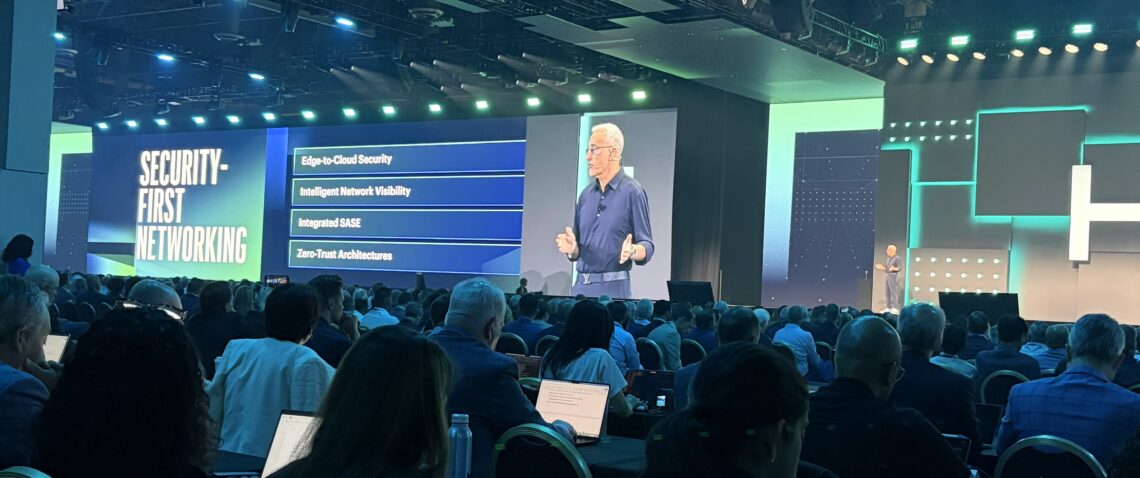
In his day one keynote, chief executive Antonio Neri spoke to the importance of a security-first networking approach that comprehends edge to cloud security, intelligent network visibility, integrated SASE, and a zero-trust architecture. By all measures, the announcements made at Discover this year support his vision. I credit HPE for elevating the importance of network modernization to be on par with GPU compute, and this is what led to its desire to acquire Juniper for its AI and service provider portfolio depth. The company is also making storage highly relevant within the AI full stack, aligning its Alletra platform to improve GPU efficiency by feeding data directly into GPU memory.
HPE is in a unique position to capitalize on its newly minted engineering depth and breadth. Its investment in networking significantly rivals that of Dell Technologies, and its strength in compute, including ProLiant GPU-based servers and the Cray Supercomputing portfolio (recently celebrating its 50th anniversary), rivals Cisco’s reinvigorated portfolio with a little help from NVIDIA. If HPE continues to innovate across its entire AI infrastructure portfolio and simultaneously manages pesky supply chain constraints, it could further its recent second fiscal quarter record-breaking financial earnings