Summary
Generative and agentic AI frameworks are empowering enterprises with dramatic efficiency gains by eliminating operational friction and enabling automation at scale. However, as modern AI applications and workload demands grow, legacy connectivity will struggle to keep pace with emerging AI threats. What is required is a unified SASE approach that delivers better business outcomes from a network assurance and security standpoint.
The recent development of frontier models that can scan previously undetected vulnerabilities at machine speed is eye-opening. It serves as a wake-up call for organizations to use more granular observability tools to identify at-risk infrastructure and deploy a zero-trust architecture to mitigate breaches through least-privilege access.
LoneStar Advisory & Research believes that Palo Alto Networks’ portfolio depth in cybersecurity and its demonstrated success as a platform leader position it to deliver a unified SASE solution that is highly adaptive, resilient, and secure from cloud to campus and branch.
Combating An Emerging AI Threat Landscape
AI is a double-edged sword. It is empowering defenders with new capabilities to address security vulnerabilities at scale, but bad actors are weaponizing it for ill-gotten gain. Consequently, a new architectural approach is needed to address legacy network fragmentation, poor visibility, inconsistent security policies, and operational inefficiencies resulting from tool sprawl. The sense of urgency is immense, especially given concerns about the weaponization of models that can identify vulnerabilities at machine speed.
A unified, secure SASE architecture can address these concerns. It leverages common policy constructs across network and security control points to eliminate shadow access, enforce access control regardless of user location, and most importantly, ensure zero-trust, least-privilege access. It also provides higher resiliency through dynamic tunneling, last-mile performance optimization, rapid failover, and application acceleration. Finally, unified SASE feeds AI operations with consistent telemetry and a unified data lake. This capability enables granular observability that improves network assurance and runtime protection, scales autonomous operations, ensures compliance, and supports the data persistence of agentic workflows.
As AI extends to branch and edge application use cases, it can also provide dynamic threat prevention, URL filtering, DNS security provisions, application visibility and packet steering, and automated SD-Branch deployment and ongoing configuration management.
Why Palo Alto Networks
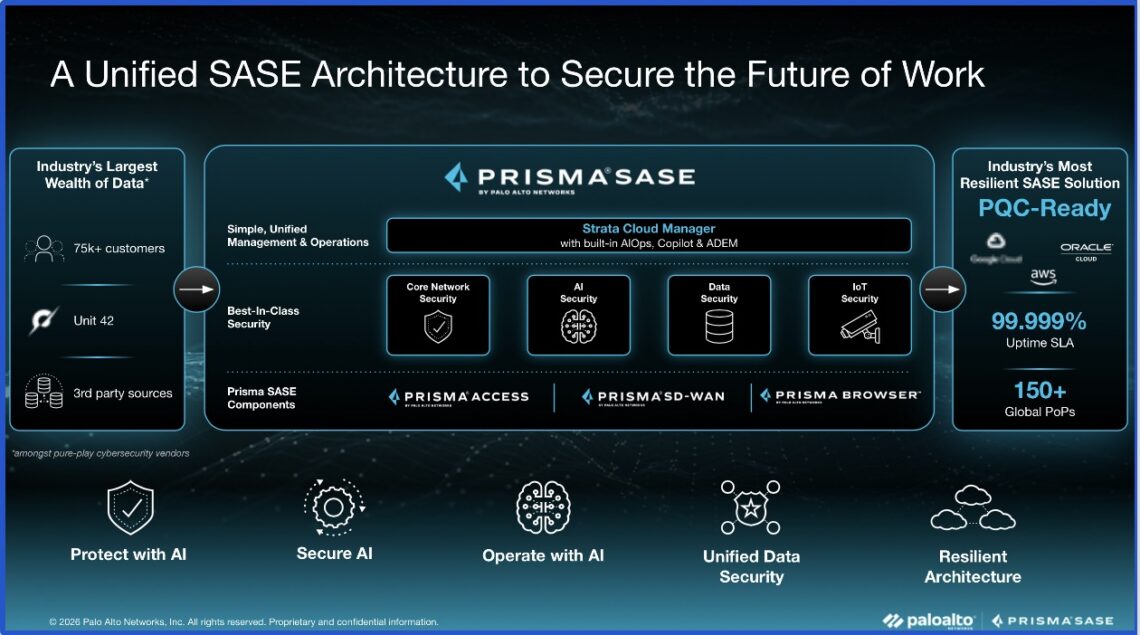
A resilient controller architecture is critical given recent industry vulnerabilities and concerns related to Mythos and beyond. Palo Alto Networks leverages common policy constructs across network and security control points. As a result, it provides greater resiliency through dynamic tunneling, last-mile performance provisions, rapid failover, application acceleration, and more. It also facilitates AIOps through consistent telemetry and a unified data lake for observability, autonomous operations, reporting, and agentic workflows.
With modern AI adoption, Palo Alto Networks addresses the evolution of the branch network by focusing on dynamic application visibility, application-based packet steering, and SD-Branch firewall capabilities. This new architecture matters because it addresses legacy concerns around network fragmentation, poor visibility, inconsistent security policies, and operational inefficiencies. Most importantly, it informs and enables the Secure SD-Branch with autonomous deployment, universal security enforcement, unified visibility, and Prisma SD-WAN’s strengths, including Palo Alto Networks branch security.
Consequently, LoneStar Advisory & Research believes Palo Alto Networks improves operational agility through agentic network operations and unified management, providing a single pane of glass across firewall, SD-WAN, and SSE through tools including its Strata Cloud Manager, the Prisma SD-WAN Troubleshooting Agent, and Palo Alto Networks AIOps.
Realizing Better Outcomes Through Platformization
Palo Alto Networks continues to trailblaze its platform value proposition, delivering a comprehensive set of capabilities across carpeted information and non-carpeted operational technology environments, the latter often characterized by highly expansive attack surfaces created by embedded devices and varied industrial control systems.
The company offers a complete AI security stack that secures the entire AI lifecycle through robust runtime controls and protects against data leakage, prompt injection, and model poisoning through Prisma AIRS, while managing the complexities of agentic identity governance and privileged access through its IDIRA platform.
Given the browser serves as the de facto interface for modern AI applications, Palo Alto Networks’ Prisma Access Browser provides another critical enterprise security control capability. It extends zero-trust access to endpoints to combat data exfiltration and emerging AI threats, allowing users to safely access SaaS, web, and private applications from both managed and unmanaged devices. Furthermore, Palo Alto Networks offers a highly capable set of complementary AIOps features that automate deployment and ongoing operations, as well as post-quantum cryptography readiness, addressing troubling harvest-now-and-decrypt-later schemes.
By offering this level of combined security functionality, along with a unified and secure SASE architecture, organizations can achieve better security outcomes while leveraging the transformative benefits of AI with trust and confidence.
A Complete AI Security Stack
As threat actors continue to weaponize AI for ill-gotten gains, organizations require a comprehensive set of security solutions that provide runtime control and zero-trust access across domains.
In a recently recorded fireside chat between Will Townsend, Chief Analyst at LoneStar Advisory & Research, and Anupam Upadhyaya, who leads Palo Alto Networks’ SASE and network security business, both discussed how the company is imbuing Prisma SASE with AI to strengthen network and security operations. Palo Alto Networks is fighting AI with AI by providing deep protection through advanced virtual patching, while other infrastructure providers focus primarily on compensating controls. It is also evolving its security fabric to meet the need to secure both humans and machines, alongside robust network assurance capabilities to support the explosive growth of network traffic generated by agentic frameworks.
Colgate-Palmolive’s journey is an excellent example of how Palo Alto Networks’ security portfolio provides the depth and breadth required to ensure uncompromised protection and highly resilient network and application performance. As a provider of consumer and household products, it needed to secure its manufacturing environments, enhance critical applications for IT and OT users, and provide visibility and consistent security policies to support employee and partner access and collaboration from anywhere. Colgate-Palmolive achieved its objectives by deploying Prisma SASE for application uptime, resiliency, and troubleshooting; using cloud-delivered security controls, including advanced threat prevention and URL filtering; and adopting Prisma SD-WAN’s flexible, highly resilient controller capability to safeguard its carpeted and non-carpeted environments.
This compelling set of features delivers a complete AI security stack, engineered and optimized to redefine secure enterprise connectivity in the AI era.