
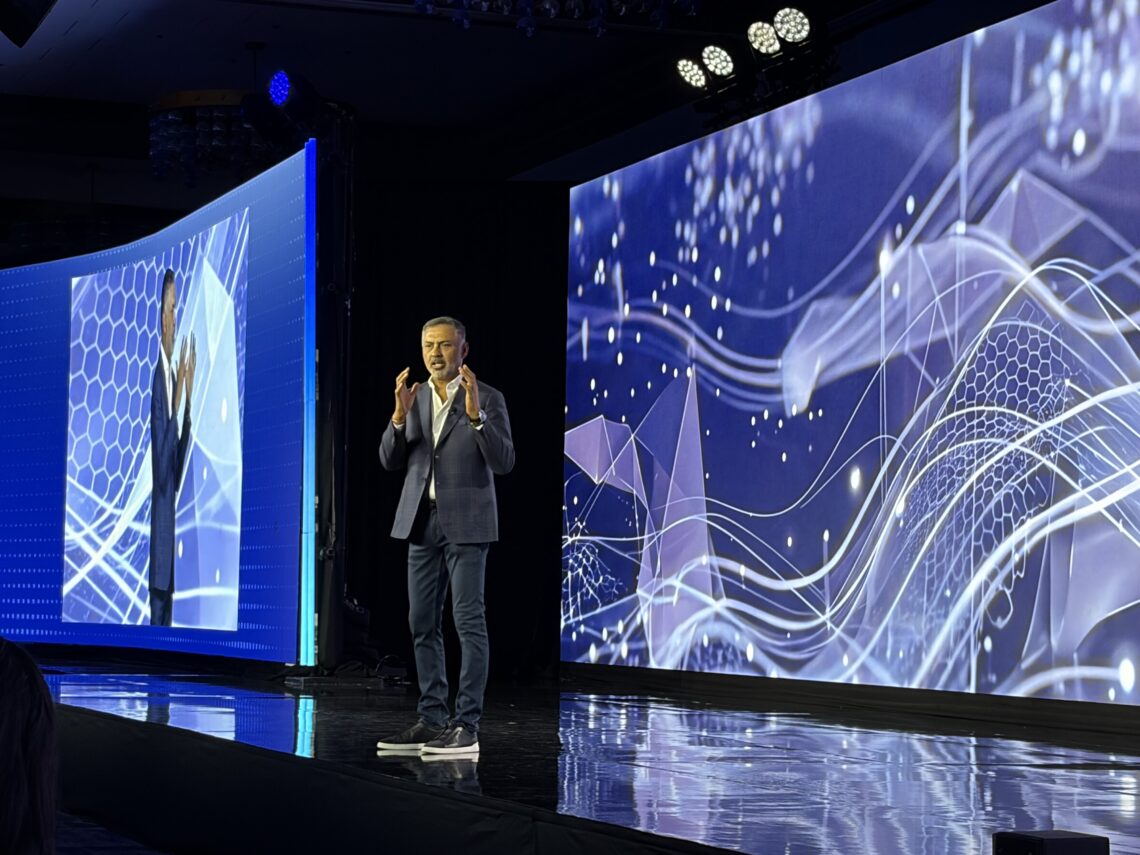
CyberArk held its Impact event in my hometown of Austin a few weeks ago. I had an opportunity to spend time with company executives and Palo Alto Networks’ chief executive Nikesh Arora. With a continued theme of summarizing my event attendance with three big takeaways – let’s dive in!
A New Brand To Address Identity Fragmentation
The biggest news coming out of CyberArk Impact was the launch of a new brand in Idira. Before the close of its $25 billion acquisition of CyberArk, Palo Alto Networks organized its product portfolios under three pillars: Strata for network security, Prisma for cloud and SASE, and Cortex for security operations and AI threat intelligence.
Now with Idira, the company aims to add a fourth portfolio pillar that quantifies identity risk, controls every privilege, and automates governance through a converged platform that unifies identity and access management, identity governance and administration, privileged access management, and non-human identity and machine security. It is a bold endeavor, but one that is needed, especially as agentic AI frameworks place new pressures on traditional human-centric identity security solutions from a scale and provisioning perspective.
I have spent considerable time with Arora in the past, and he argues that identity security is a fragmented category ripe for consolidation, and I wholeheartedly agree. If Idira can deliver CyberArk’s traditional PAM depth with user experience enhancements, improved governance, and optional agentic and machine identity security, it is a home run from my perspective for both customers and Palo Alto Networks’ channel sellers.
The Rise Of Identity-Centric Zero Trust
There is a new flavor of zero trust, least privileged access emerging, and it involves prioritizing identity over network, endpoint, and perimeter controls. On the surface, it makes sense given that a staggering majority of breaches are a result of identity and credential compromise.
During Impact’s keynotes and breakout sessions, identity-centric zero trust was a consistent theme. In the agentic AI era, the need for continuous identity verification, contextual authorization, and behavioral monitoring is critical. Furthermore, the use of adaptive, just-in-time authentication schemes, session isolation, and zero standing privilege to reduce always-on privileged access are fundamental considerations given the ethereal nature of agentic workflows. A slew of solution enhancements made at Impact support these capabilities, and it will be interesting to gauge how quickly Palo Alto Networks can monetize the concept of identity-centric zero trust.
New Growth Opportunities
Palo Alto Networks points to the need to mature CyberArk’s historic strength in PAM to position itself to take ample advantage of machine identity security as a future top-line revenue and profit growth driver. Broadly speaking, the company is well-positioned, with new capabilities announced at RSA Conference that includes the automation of public key infrastructure and certificate lifecycle management. Improved agentic AI governance with tools that are purpose-built for workload identity protection and supply chain resilience are also promising.
Broadly speaking, Palo Alto Networks will open new doors for CyberArk, through a much larger channel presence and footprint. It is difficult to measure the accretive value, but suffice it to say it should be a significant net positive.
Final Thoughts
During his Impact keynote, Arora discussed the evolution of cybersecurity platformization, providing his perspective that it was driven to eliminate customer complexity with stitching solutions together rather than serving as a sales aggregation engine. I believe it has accomplished both objectives for Palo Alto Networks. As enterprises reduce tool sprawl, it improves operational efficiency and business outcomes.
The company is by all measures the defacto leader in leaning into the power of the platform as measured by its consistently positive financial performance, and it has now added identity to round out its cybersecurity market dominance.