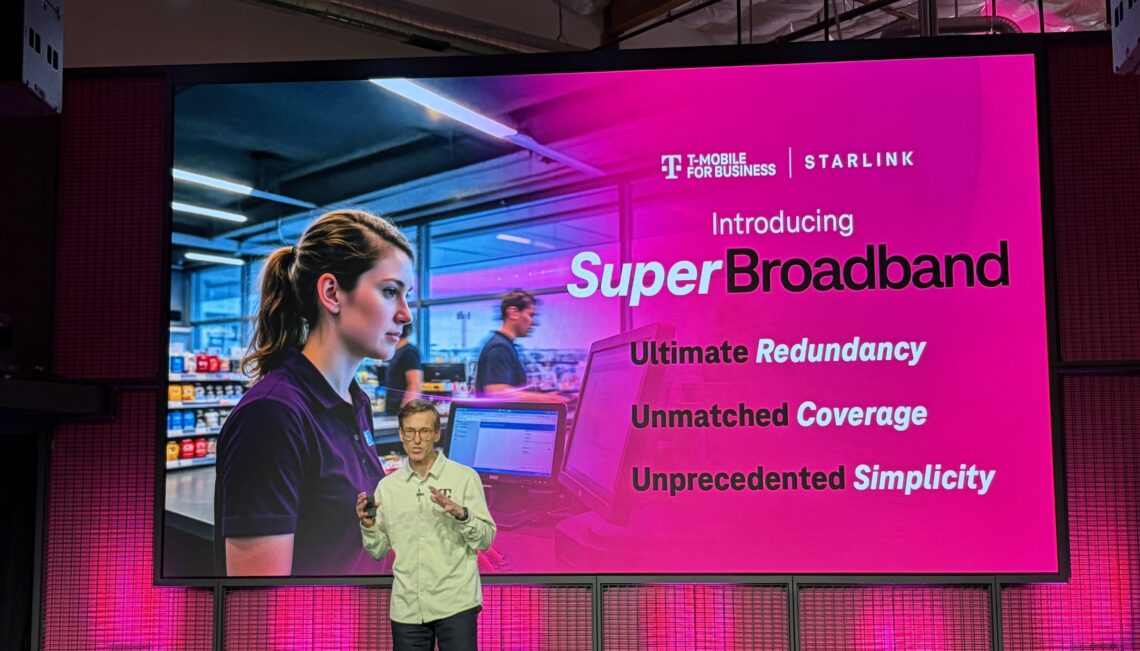
I recently spent time with T-Mobile For Business executives and partners, including Ericsson Enterprise Wireless and Inseego, at the Uncarrier’s Innovation Hub in Bellevue to dive deeper into a new business internet offering dubbed SuperBroadband. The announcement follows another “super” mobility business service launched last August, and this one promises to address a fundamental issue that multi-site businesses have struggled with for years – regional broadband service fragmentation.
What Is SuperBroadband?
T-Mobile’s recently fielded Voice of the Customer research surfaced three important considerations for its current business internet subscribers. First, reliability and redundancy are non-negotiable. Second, nationwide coverage across locations is critical. Third, simplicity delivered through a fully managed service that scales is a hard requirement.
SuperBroadband aims to address these considerations, converging two networks into a single solution that is fully managed by T-Mobile and built from the ground up and sky down. It claims to be the first offering that bonds a terrestrial Standalone 5G fixed wireless access service with Starlink’s low-earth-orbit satellite constellation connectivity to deliver redundancy and coverage to every zip code in the United States. Most importantly, it does this through a single contract and a single pane of glass. To say this is a heavy lift technically and operationally is an understatement, and the potential to solve an issue that has plagued businesses for decades is powerful.
The fully managed service runs in two modes. The first mode is 5G primary and Starlink standby to deliver redundancy and failover. The second mode is 5G primary and Starlink primary to offer load-balancing support for higher traffic profiles and unpredictable demand. Furthermore, SuperBroadband can also be placed behind a fiber or cable service for additional redundancy in mission-critical applications that span critical infrastructure, healthcare, and other highly regulated business segments. Managed through T-Platform, the operational console provides real-time availability status, usage and performance metrics designed to optimize performance, and self-service capabilities to facilitate provisioning and resolution of other operational issues. Executives shared pricing, and suffice it to say it is aggressively priced, offering three tiers to offer flexibility based on capacity needs.
Ericsson Enterprise Wireless Solutions (formerly Cradlepoint) is T-Mobile’s initial SuperBroadband launch partner, providing the underlying routing infrastructure and orchestration software with its NetCloud Manager integrated into the T-Platform management console. For ecosystem diversity, T-Mobile is also collaborating with Inseego as a future integration partner.
Delivering Better Business Outcomes
At the launch event, T-Mobile invited three customers to share their insights as beta program participants. Apparel maker Columbia, Aramark’s Destinations business unit, and Shell shared their experiences related to the operational benefits of a unified service that eliminates the need to manage multiple ISP offerings, a single pane of glass that reduces operational friction, and the value associated with a turnkey offering that leverages the power of bonding terrestrial and non-terrestrial networks to reach any location. Broadly speaking, it is a powerful set of capabilities that will likely be replicated globally by other mobile network operators in the future
Final Thoughts
One of my early criticisms of T-Mobile was its nearly exclusive focus on consumer services, except for a handful of white-labeled enterprise business solutions, including SD-WAN. That has changed over the past four years, with the introduction of its hybrid public and private Advanced Network Solutions, network-sliced T-IoT, T-Priority, SASE, and SuperMobile offerings, and now SuperBroadband.
As many operators continue to complete 5G Standalone deployments, T-Mobile continues to accelerate its business service innovation. In doing so, the Uncarrier is raising the bar for delivering better subscriber experiences and is commensurately growing its top-line revenue and margins in a telecom industry that tends to focus on traditional lower margin access services.
It is not surprising that T-Mobile’s parent, Deutsche Telekom, is taking notice and currently exploring the possibility of exercising a right to take its 53% equity stake in T-Mobile to 100%. That would require regulatory approval in both Germany and the U.S., but the potential to combine both entities into a single holding company could result in an astonishing market cap of half a trillion dollars. Time will tell if it comes together, but one thing is certain – T-Mobile is clearly raising the bar for business connectivity services.