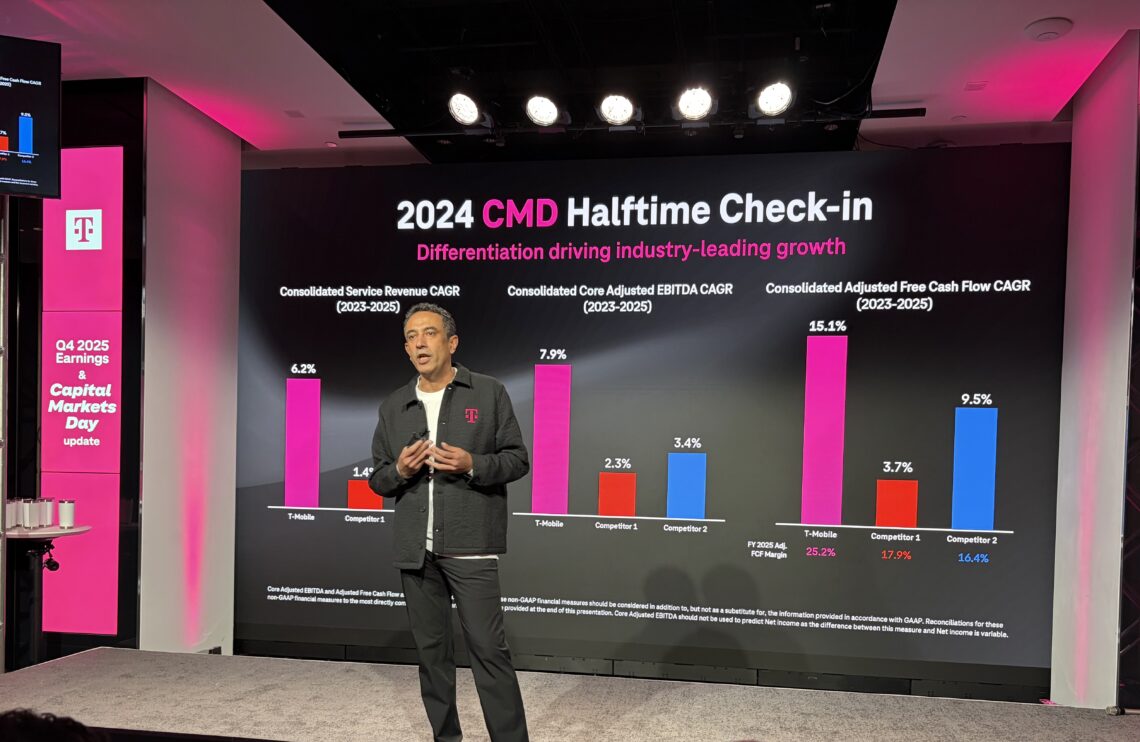
I had the opportunity to attend T-Mobile’s Capital Markets Day in New York City on February 11. Over two and a half hours, chief executive Srini Gopalan and his executive leadership team took a group of industry and financial analysts through a look back and a look forward at its overall business, including its recent Q4 and full-year 2025 financial results. Three things stood out for me:
First, the “Uncarrier’s” relentless focus on continually refining its network capabilities, subscription value, and customer experience is resulting in significant top-line revenue growth, exceptional gross earnings, and substantial free cash flow. In Q4, this equated to 2.4 million postpaid net customer adds and 7.8 million for 2025. 5G fixed wireless access services continue to deliver impressive results as well, with half a million in the quarter and nearly 2 million for 2025. Fiber also added 2 million net subscribers in 2025, and joint ventures with several providers should provide headroom for future growth. These achievements led to an impressive overall service revenue of $71.3 billion for the year.
Second, T-Mobile highlighted incremental growth opportunities, including advertising to its 24 million active users on its T-Life app, a foray into financial services starting with a co-branded Visa credit card, and active exploration into physical AI and edge use cases in partnership with Nvidia. From my perspective, physical AI may become the killer use case for future 6G connectivity, with a potential total addressable market for mobile network operators in the trillions of dollars.
Third, at the event, the company launched a new live voice translation service, powered by AI and integrated into its core networking infrastructure, supporting 50+ languages. It is a powerful offering, does not require an app, and is likely the first of many AI-powered offerings that could delight customers, drive stickiness, and create future incremental monetization opportunities for T-Mobile. A beta is available with expected service availability in the spring, but I would have liked to test it out at MWC Barcelona next month, given my rusty Spanish!
From my perspective, it all starts with offering the most reliable, performant, and programmable mobile network that balances widespread coverage needs. T-Mobile has leveraged the 2.5 GHz spectrum it acquired with its 2020 Sprint acquisition to build its mobile network leadership position, and the close of its acquisition of USCellular spectrum assets, leased tower infrastructure, and 4.5 million customers last year has the potential to sustain its market share momentum.