Juniper Networks recently made two announcements that have the potential to dramatically accelerate the sales of its automation and AI-driven enterprise networking platforms. Consequently, I would like to provide my insights into what I find most compelling about each.
Automation alignment under Paragon
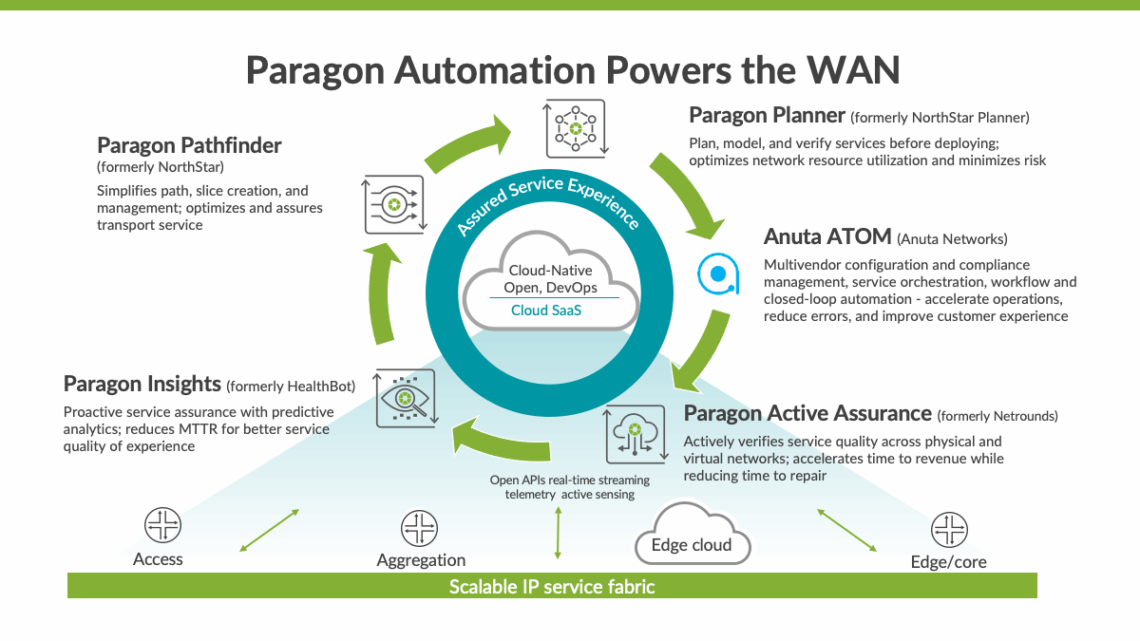
From my perspective, over the past year, Juniper has quickly assembled an impressive automation capability. Recently, the company announced a realignment initiative that better positions its various automation infrastructure components. I want to examine each in further detail:
- Paragon Pathfinder (formerly NorthStar Controller) is a software-defined networking controller that simplifies traffic engineering by automating segment routing and IP/MPLS data flows across a broad continuum of networks, from service provider to cloud to enterprise networks. The offering seeks to provide visibility into network traffic flows in real-time by gathering streaming telemetry. It then analyzes the data to provision new service paths and optimizes capacity and performance. It allows network operators to maximize the utilization of their network capacity while ensuring predictability, resiliency, and service-level guarantees. I believe it can deliver network operations staff agility and improve the quality of service and application performance.
- Paragon Planner (formerly NorthStar Planner) is a network modeling tool that enables network visualization, planning and offline simulations. I believe it will help network operators forecast the impacts of network changes with respect to latency and shifts in traffic flows, and to become more proactive while increasing speed of deployment.
- Paragon Insights (formerly HealthBot) is a multi-domain network diagnostic solution that provides actionable insights into network operations. The solution aggregates time-series telemetry data, employing machine learning and programmability to provide a comprehensive view across the network and applications. I believe that these capabilities will improve benchmarking, uncover anomalies, and provide better quality of service.
- Paragon Active Assurance is the result of Juniper’s recent Netrounds acquisition. It actively verifies service quality on the data plane across physical and virtual networks and aims to accelerate time to revenue, guarantee service quality while remediating issues faster. Time will prove its capability, but on the surface, it is a compelling and proven solution already in production with tier 1, 2 service providers and various federal organizations.
- Finally, Juniper’s partnership with Anuta Networks fills a critical gap in supporting multi-vendor configuration and compliance management, service orchestration, workflow, and closed-loop automation. Anuta delivers a robust set of tools that scale massively and can accelerate operations, reduce downtime, and improve the overall customer experience. Honestly, I am surprised that Juniper did not acquire Anuta because its grounds-up, microservices-based architecture is compelling – something that I recently analyzed in a research paper. If interested, you can find it here.
Delivering on the promise of an AI-driven enterprise

The enterprise market finally began to open up to Juniper with its Mist Systems’ acquisition nearly two years ago. Mist’s focus on AI is one of its key differentiators, and Juniper has embraced it in a big way. In late February, the company made a handful of announcements to expand on its client-to-cloud vision, including enhancements to its SD-WAN offering with Session Smart Routing (SSR), a new EX4400 family of switches, and cloud support for branch AIOps with its Branch SRX platform.
- SSR is a tunnel-less architecture that has the potential to reduce infrastructure and bandwidth costs, support rapid scale-out, reduce latency for an improved customer experience, improve visibility and provide meaningful insights, and deliver zero-trust capabilities. The Mist Cloud is integrated with SSR, pulling WAN telemetry data, and bringing AIOps to the SD-WAN platform. I am impressed with how quickly Juniper has brought SSR under the Mist AI umbrella for assured user experiences, proactive automation, and advanced insight using Marvis, Juniper’s AI-driven virtual network assistant with a natural language conversational interface.
- The EX4400 is a new access switch that integrates the Mist AI engine to rapidly onboard devices, support standards-based micro-segmentation, mitigate security threats, and automate NetOps. In addition to being completely cloud-ready out of the box, the EX4400’s hardware specs are compelling with 10-member virtual chassis, 90W/port POE/POE++ and MACsec AES256.
- Finally, the SRX platform aims to simplify branch deployments with improved provisioning, orchestration, and configuration management through the Mist Cloud.
Wrapping up
Juniper has made significant inroads into the enterprise space through roadmap realignment, acquisitions, and partnerships. As a result, the company is no longer a “one-trick” service provider pony, as evidenced by growing its enterprise business to $1.6B in its last fiscal year. From my perspective, the company has done an excellent job in positioning itself with a complete set of solutions from A to Z. Competition breeds innovation and choice, and thus networking customers stand to benefit from Juniper’s improved market position.
Source: https://www.linkedin.com/pulse/juniper-networks-delivers-from-ai-z-will-townsend/