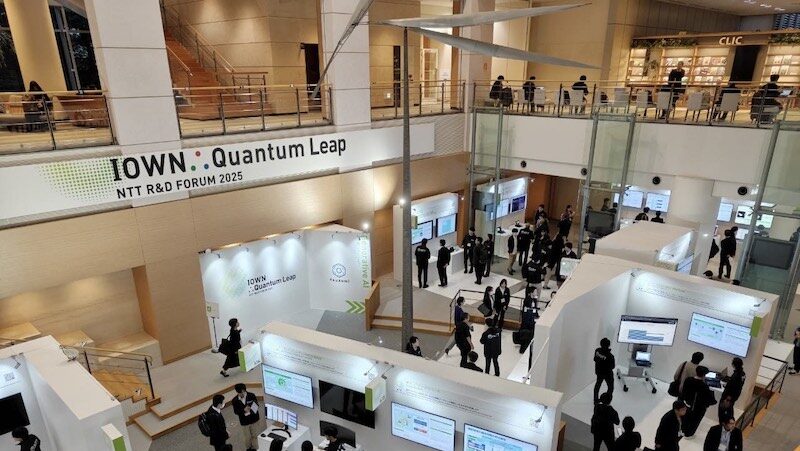
This year marked my third visit in as many years to NTT’s R&D Forum in Tokyo. The event’s theme of a “quantum leap” was a clever play on words related to the highly performant connectivity needed for future quantum computing workloads — and it reminded me of the television show of the same name from the early 1990s.
I continue to be impressed with NTT’s forward-looking approach to connectivity, embracing its historic strengths as a solution integrator, optical networking infrastructure provider and telecom mobility services operator with its Docomo business unit. This represents a unique set of capabilities that are further augmented by NTT’s broad ecosystem of partnerships.
At the multi-day event, I saw nearly a hundred technical demonstrations and learned more about how NTT’s Innovative Optical and Wireless Network Global Forum hopes to further the adoption of an ambitious all-photonics network. I also took the opportunity to learn more about how Docomo partners with academic researchers for its pioneering sensing technology development efforts, with the goal of creating a future “killer” 6G application. Let’s dive in.
High-Impact Applications and Use Cases
NTT’s R&D Forum serves as a showcase for the company’s deep investment in research and development. NTT consistently ranks as a top global patent recipient, although I never measure a company’s innovation potential by counting patents. What matters is business outcomes and the potential to transform enterprise operational control or entire industries. To this end, three technical demonstrations stood out for me at the event — for remote driving, agentic AI and a reimagined network switch.
First, NTT’s Advanced Remote Driving Technology incorporates unique communication and image stabilization features developed by the company in partnership with Toyota. The underlying video transmission and compression algorithms are fine-tuned to focus on only those critical elements needed for remote operation. It is not necessarily a new use case, given that services from Halo and Vay exist today, but NTT recently formed a mobility business unit to further refine its tech stack to drive scale and widespread adoption, with further plans to deploy services to more than 100 locations by 2027. During the demonstration, I watched a colleague pilot a vehicle hundreds of miles away over the company’s Docomo 5G network, and the responsiveness and articulation was impressive.
Second, AI Constellation is an NTT agentic AI framework that aims to enable sophisticated decision-making through consensus-building around complex issues such as social problems by efficiently extracting knowledge that covers various viewpoints. By merging data analysis across multiple large language models, it is designed to facilitate broader evidence-based decisioning. It also incorporates an orchestration super-agent to mitigate bias and resulting hallucinations. The latter capability is interesting, and something that I have not seen incorporated within other agentic frameworks. From my perspective, it has great potential to address one of the biggest concerns that enterprises have with modern AI applications: trust in AI.
Third, a photonics-electronics convergence device based on NTT’s photonics technology stack facilitates communication between datacenters with a purpose-built optical switch that the company refers to as a PEC device. The multiyear PEC roadmap calls for building from a commercialized interconnect card that exists today to deliver inter-board, inter-package, and intra-package designs by 2032.
Co-packaged optics have become a hot topic of discussion this year, given their value for integrating optical components with network silicon and AI accelerators, which can improve signal loss over longer distances and dramatically reduce power consumption. NTT believes that it can achieve the same with PEC, and I believe this is a potential game-changer given the power-hungry needs of modern AI applications and workloads. During the demonstration, I recognized a swath of computing infrastructure partners including Dell Technologies and Supermicro.
IOWN Global Forum
The IOWN Global Forum is tasked with advancing NTT’s vision for an all-photonics network, and the benefits could be staggering — reducing power consumption by a factor of 100, boosting transmission capacity by 125x and lowering end-to-end latency by 200x. It is an ambitious multiyear effort with enormous potential to bring needed sustainability and higher performance to support emerging AI applications and workloads.
Nearly 200 members, including technology stalwarts AMD, Cisco, Dell, Ericsson, Google, HPE, IBM, Intel, Microsoft, Nokia, Nvidia and Qualcomm, are collaborating to accelerate the development of communications infrastructure that replaces less-efficient electronic components with photonics. Use cases span construction, financial services, media production and more through four discrete investigation areas — distributed computing and infrastructure, energy efficiency, optical networking and photonics and remote GPU services. It is an exciting endeavor, one that has the potential to allow networking to keep pace with the need to move data for training and inferencing of cloud-hosted LLMs as well as smaller language models hosted on-premises and at network edges.
NTT Docomo’s Sixth Sense
I had another opportunity this year to spend time with NTT Docomo at its headquarters in Chiyoda City, Tokyo. Last year, I was provided an early preview of the company’s Feel Tech and Human Augmentation Platform, and I left impressed with its potential.
Today, Docomo is positioning that technology as an integral part of its future 6G platform expected in 2030. Through partnerships with academia and Japanese startups, it is enabling haptic response through robotics, and quantifying taste, pain, motion and skill-sharing to perform tasks remotely. Docomo also highlights a few interesting use cases, including infrastructure inspection, healthcare applications and commercial driver management systems designed to analyze risk and enhance safety. I like the integration of sensing within Docomo’s 6G platform vision, given that it moves beyond the typical generational improvements for mobility in terms of throughput, latency, security and device support.
It Takes a Village
The NTT R&D Forum continues to serve as a showcase for the company’s innovation and deep partnership model. Often, networking is lost in the conversation of improving GPU and NPU silicon performance. Ethernet continues to mature, and new scale-across capabilities hold a lot of promise for AI datacenter clustering. However, at some point in the future, more will be needed from a connectivity perspective, especially with the expected intersection of modern AI and quantum computing. It will take a village to advance networking, and what NTT and its ecosystem are doing has great promise.